

Skills development: why wait until September?
Skills development should not stop just because the pace slows down during the summer.
It should simply take a different form.
In many organizations, the summer period brings fewer meetings, smaller teams and slightly lighter schedules. It may seem like this is not the right time to learn.
I believe the exact opposite.
Summer offers a rare opportunity: the chance to step out of urgency mode. When the noise quiets down, we can take a step back, develop a skill and learn without feeling like we are adding one more obligation to an already full week.
Slowing down does not mean stopping progress
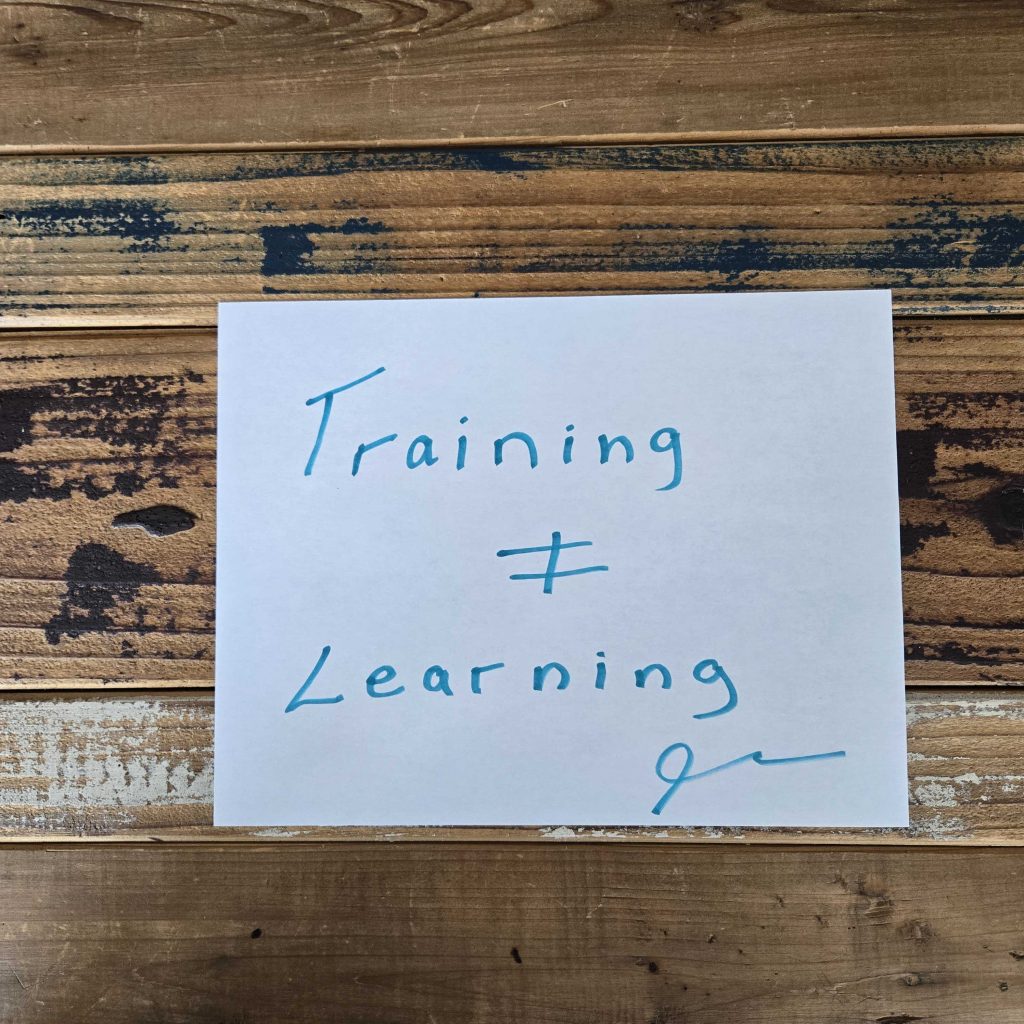
We often have a very structured view of training: a program, modules, an assessment and a certificate.
These learning paths remain essential, but continuous learning is not limited to that.
It can also take the form of an article that makes us think, a podcast, a conversation with a colleague or a new method tested in daily work.
Summer is especially well suited to this kind of learning.
It is not the number of hours that matters
Making training lighter does not mean reducing its quality.
The real question is not:
“How many hours have we dedicated to training?”
But rather:
“What will people understand, decide or do better after this learning experience?”
That is where the real value lies.
Four ways to develop skills during the summer
1. Choose one skill
There is no need to try to learn everything at once.
Communicate better.
Delegate better.
Use artificial intelligence better.
One well-chosen skill can have much more impact than several scattered learning efforts.
2. Focus on a few quality resources
We do not lack content.
What we mostly lack is time to choose what truly deserves our attention.
A few carefully selected articles, podcasts or short learning capsules are often worth more than an entire library.
3. Share knowledge
Knowledge already exists within every team.
Creating opportunities to share best practices, mistakes and lessons learned turns individual knowledge into collective intelligence.
4. Test immediately
A skill becomes real when it changes a behavior.
Try a new way of facilitating a meeting.
Test a new tool.
Change a habit.
Small changes often create the biggest results.
The skills of the future remain deeply human
When we talk about the skills of the future, the conversation quickly turns to artificial intelligence.
And yet, the skills that will truly make a difference are often human.
Curiosity.
Communication.
Empathy.
Judgment.
The ability to decide despite uncertainty.
The ability to learn… and then unlearn.
These skills are not developed only in a training room.
They are built through conversations, experiences and the everyday moments that challenge how we think.
The role of managers
A learning culture does not rely only on a platform or a training catalogue.
It relies first on managers.
Creating time.
Encouraging curiosity.
Valuing knowledge sharing.
Allowing experimentation.
And showing, by example, that learning is part of the work.
It is just as important to respect vacation periods. Supporting skills development does not mean turning every free moment into an opportunity for productivity. Vacations should remain vacations.
Flexibility is part of the strategy
The organizations that learn best are not the ones that offer the most content.
They are the ones that make learning simple, relevant and accessible.
Before waiting until September to relaunch all your training initiatives, ask yourself one question:
What skill would you like to develop before the end of the summer?
Sometimes, one answer is enough to guide everything else.
Philippe Richard Bertrand
President and Chief Vision Officer