
For decades, we have repeated a message to our children that seemed self-evident.
“Get a good education, find a good job, and you’ll have a successful career.”
For a long time, that promise was realistic.
You chose a profession, built your expertise, and, in many cases, spent 30 or 40 years doing essentially the same job. The tools evolved, but the profession itself remained largely unchanged.
I’m no longer convinced that’s true.
Since the pandemic, one statistic has stayed with me.
According to the World Economic Forum’s Future of Jobs Report 2025, 59% of workers will require reskilling or upskilling by 2030, while nearly 40% of today’s workplace skills are expected to change or become obsolete.
When I read those numbers, I don’t think about my company first.
I think about my two boys.
My oldest is finishing CEGEP.
My youngest is approaching the end of high school.
Like every parent, I hope they find work they love and build fulfilling lives.
But one question keeps me awake at night.
Are we truly preparing them for the world they are about to enter—or are we still preparing them for the world we grew up in?
Let me be clear.
This is not a criticism of our teachers or the remarkable work they do every day.
I simply wonder whether the pace at which we educate is still aligned with the pace at which the world is changing.
A few days ago, one of our guest bloggers, Francis Gosselin, published an excellent article on the profound economic transformations taking place around us. His message was clear: we are not simply living through another period of change we are witnessing a fundamental and lasting redefinition of the labor market.
His article resonated deeply with me because it reflects the conversations I have every week with business leaders.
What if our greatest challenge is no longer preparing someone for one career, but preparing them to learn many careers throughout their lifetime?
I believe that many young people entering the workforce today will need to learn, unlearn, and relearn continuously.
For many professions, it will become normal to acquire entirely new specializations—or even reinvent oneself completely—every three to five years.
Not because they failed.
But because the world around them changed.
That is a fundamental difference.
In fact, Harvard Business Review argues that the highest-performing organizations can no longer rely solely on teaching the latest technical skills. Instead, they must develop a genuine capability for continuous learning—one that evolves alongside markets, technology, and society.
In other words, the most valuable skill may no longer be programming, marketing, accounting, or law.
It may simply be the ability to learn quickly.
I am convinced that the skills that will truly matter in the years ahead are deeply human.
Critical thinking.
Creativity.
Curiosity.
Communication.
Collaboration.
Adaptability.
Judgment.
And above all, the desire to keep learning throughout life.
These are the skills that allow us to use new technologies rather than be replaced by them.
That’s why I believe it’s time to rethink how we define success.
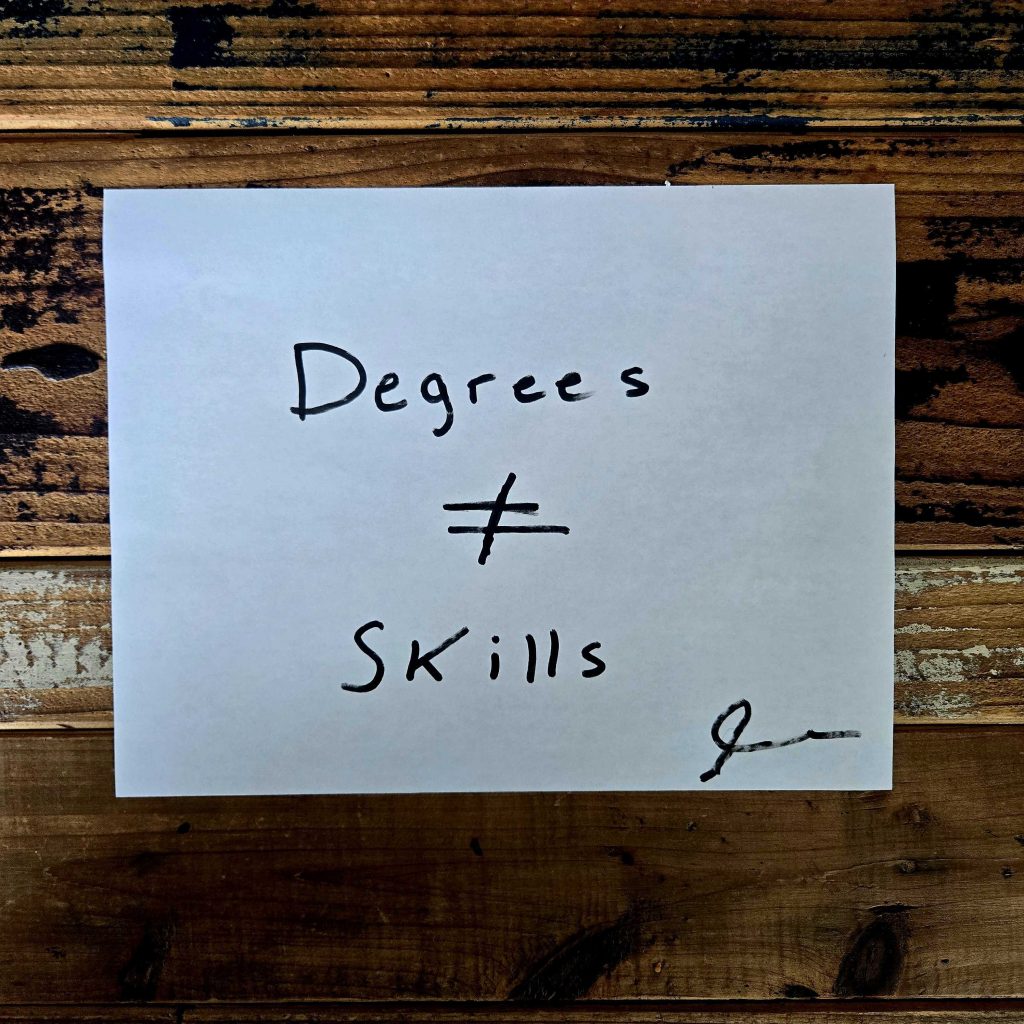
A diploma will always represent a tremendous achievement.
But it should no longer be viewed as the finish line.
It is the starting line.
Our children’s greatest competitive advantage will probably not be their first degree.
It will be their ability to earn the next one.
And the one after that.
And the one after that.
Perhaps the greatest responsibility of our education system is no longer simply to prepare young people for their first job.
Perhaps it is to give them both the desire—and the tools—to become lifelong learners.
Because in the world that lies ahead…
A diploma opens one door.
The ability to learn opens them all.
To prepare teams for the future of work, organizations need flexible training tools that help them develop strategic skills over time. With illuxi, it becomes easier to create, deliver and evolve training content that supports continuous learning.